I am not a relationship expert, but I have been married for 24 years, I have a (presently) happy and healthy child and I have (some) friends, and this one concept I'm going to share is one I rediscover repeatedly throughout these relationships.

I first came across the idea of differentiation in David Schnarch's "A Passionate Marriage" which was required reading during a course of couples therapy fairly early on in our marriage.
"Differentiation is your ability to maintain your sense of self when you are emotionally and / or physically close to others — especially as they become increasingly important to you."
—David Schnarch
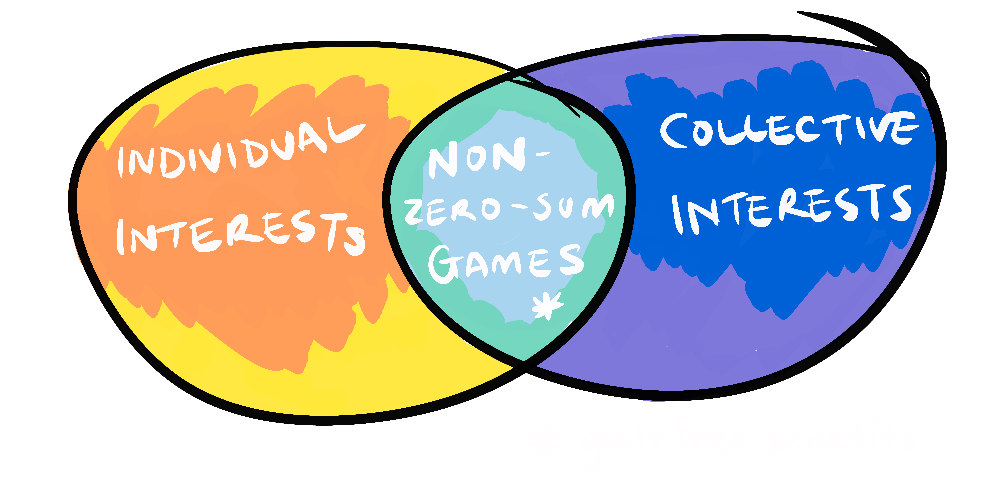
This concept has not only helped in keeping our marriage going as long as it has, but I've discovered it's utility in other relationships. In this post I'll give 3 examples from the different relationships in my life, and perhaps you'll notice parallels to your own, but first, I want to illustrate how differentiation is a non-zero-sum idea.
There was a lot of talk in "A Passionate Marriage" about sex, which made for vivid imagery to help illustrate what differentiation is. But the lessons are more generalisable than that. Schnarch uses the example of sexual interests to show that in any relationship there is a venn diagram of sexual proclivities.
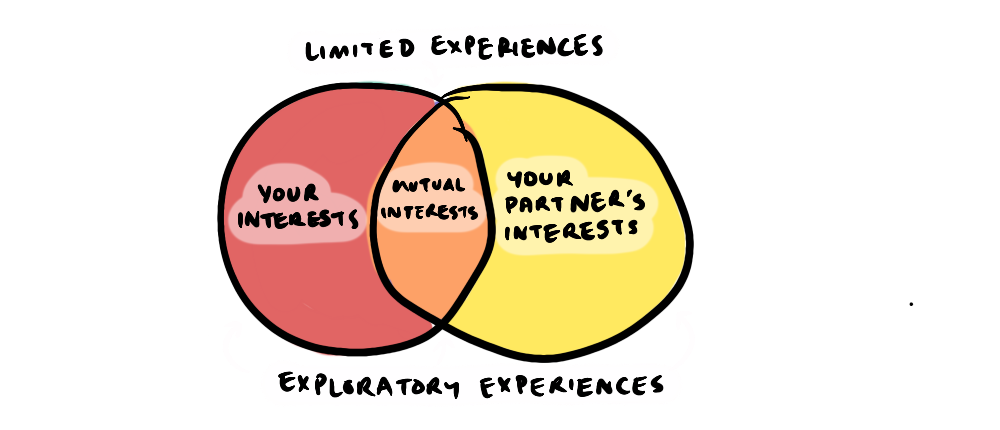
You can see how a relationship naturally has an overlap of interests, which is itself non-zero-sum. Relationships are often described as being "50/50", but they're not really. People are generally in a relationship because they gain something individually from their partner, but also, their partner gets something from them. So, a relationship might be "75/75" or "68/83" or, if only for a moment... "100/100". But that's not where it ends.
Because common interests are mutually beneficial, they can become the default, the lowest common denominator. As this becomes the norm, and those activities may become predictable, they can be taken for granted and the equation might start to feel more zero-sum. But Schnarch suggests that, while this is natural, it is also solvable if you are open to digging into your individual interests and those of your partner.

Schnarch describes marriage in particular as "a people growing machine". So, over time, a marriage grows beyond its original bounds with an appreciation for each other's unique interests. This is achieved in a spirit of acknowledging the differences between you...
... not by:



By being willing to acknowledge the unique interests of each other, you give scope for fruitful changes in the relationship, while failing to do this, staying comfortable, can result in a shrinking of possibilities where even your common interests can lose their shine, and this extends far beyond the bedroom.
For my wife and I, our issues with differentiation happened to be outside the bedroom entirely (sorry, boring, I know). Without going into too much detail, my wife struggled with me spending time away from her, either alone or with friends, and I struggled with a need to share all of my creative exploits with her, as if I needed her stamp of approval on everything I did. In these respects we were poorly differentiated, and this had to do with a need for...
Both of us were seeking validation from each other, and when we realised that's what we were doing, we were able apply the principle of differentiation to find a balance, where we would both be less needy, and at the same time more compassionate about those particular needs in the other. To do this we both needed to hold on to our sense of self—finding internal validation while we were with a person whose presence and approval were very important to us.
With friends, differentiation plays a role too, especially in close friendships where an asymmetry arises. This might be because one of you gets really busy, perhaps they have a new job, or have met a new partner, had a child or are simply at a different life stage.

There can be a tendency in these situations for the more available party to cling to the other, which in turn can drive the other way.
Strangely though, the impulse to cling, and the impulse to escape are often both a result of the same core problem, a lack of differentiation otherwise known as emotional fusion. The person clinging needs the validation of the other, the person escaping feels they can't hold on to themselves in the presence of the other.
This gets framed as "the more you want this, the less I want this" echoing the zero-sum position that for me to win you must lose. But the result is both sides lose, a negative-sum game, because both friends have failed to self-validate in a way that means they can tolerate differences in the relationship.

This intolerance to difference romantically or platonically can feel like it invalidates the relationship, but if even just one of the parties in any relationship can employ differentiation, they can start to pave a path back to balance.
But does this work for relationships that are by their nature a-symmetrical?

There are many tropes of parenthood that play on the idea of parents who are poorly differentiated from their children; "dance moms" play out their missed childhood dreams vicariously through their daughters, insecure fathers try to protect their own masculinity by eschewing any traits in their boys they associate with femininity. And we see the same with children who are poorly differentiated from their parents; the 4 year old who clings to their dad's leg upon arrival at a friends birthday party, or the teenager who screams "You're literally ruining my life" at their mum for packing their lunch. Like the friend or partner who seeks escape, their emotional fusion with their parents develops into a fear of losing themselves.

Teenagers eventually have to leave, and so the need to escape is more a feature than a bug. But it still can be difficult. I notice already with my daughter at 12 that the interests we shared during her childhood, in history, evolution and philosophy, a love of maths, word games, board games, are still there, but are being crowded out by an interest in celebrity gossip, clothing and... boys. I also see parents complaining that their pre-teens only ever talk about their online lives, about social media or video games.
So, can we employ differentiation to remain close while our interests diverge?
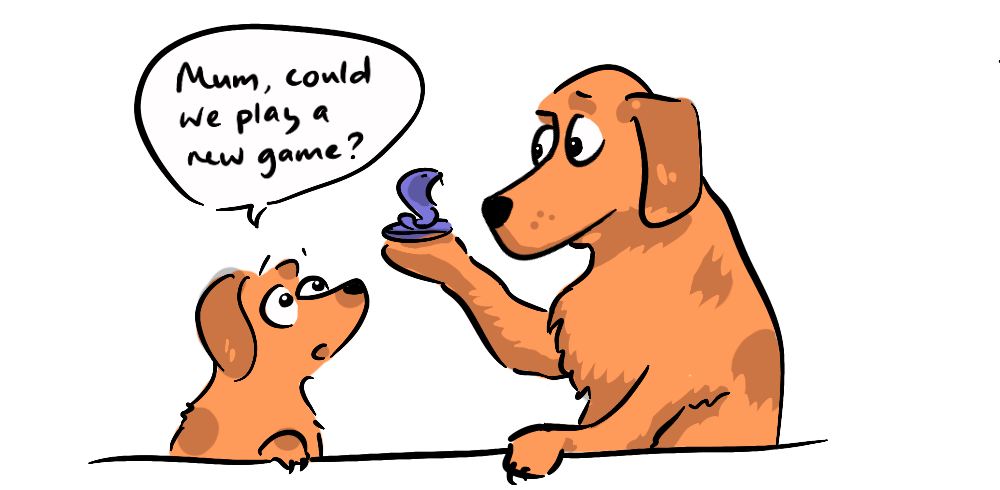
The lessons we can tasked with teaching our children are context independent. A conversation about celebrity heart-throbs doesn't have to be approached with rolling eyes, it can be an opportunity to discuss the counter-intuitive convolutions of sexual selection. A conversation about a video game like Roblox's "Adopt Me" can be a conversation about the logic of trade and investment (most video games are just covert economics). A conversation about clothing can be an entry point into design or sewing.
Bear in mind, I don't mean parents should shift the conversation to one that interests them but rather, by really listening to the content of our child's interest, we can recognise they are thinking deeply about that.
A book about dragons is really a book about relationships, but until you understand the dynamics of the relationships between the dragons, you won't be able to intelligently engage with the material. The way I see my role as a parent is scaffolding critical thinking regardless of the topic. The work is seeing the value in a topic where it's not immediately obvious—and remember the kid is doing plenty of catering to our interests too, they spend a large part of their day studying subjects at school where the utility to them is not immediately obvious either.
Parenting is a really significant example of a non-zero-sum game, as with a child you are essentially creating something from nothing—a whole person, that hopefully outlives you and carries into the future not only some of your genes but also some of your dreams and values. It is not without cost, but the cost is limited, the person your child grows into is not.
I've found that employing differentiation (when I remember to do so) transforms relationships from a zero-sum tug-of-war into something more generative. Across marriage, friendship, and parenthood, the same pattern holds: holding on to yourself doesn't push others away—it gives them something real to connect with. Staying genuinely curious about who the other person is, rather than needing them to be fused with you, gives the relationship room to breathe and grow.